Partner POV | How Zscaler Zero Trust Firewall Protects Against AI-Driven Attacks
This article was written by Karan Dagar, Senior Product Marketing Manager at Zscaler.
That shift is significant because many enterprise defenses were built for a different era. Legacy, IP-based perimeter firewalls rely on known signatures, fixed indicators, and suspicious destinations. But AI-driven attacks do not behave that way. They learn, adapt, and retry—rotating domains, adjusting timing, blending into normal traffic, and using both web and non-web protocols to find the easiest path into an environment.
This is where the Zscaler Zero Trust Firewall story becomes especially relevant.
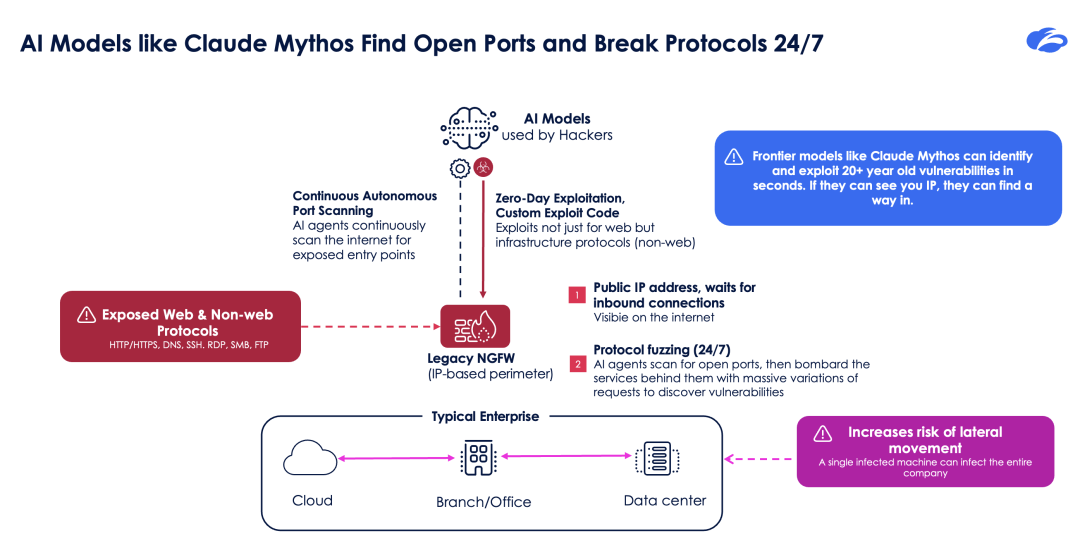
The first advantage AI gives attackers is scale. When organizations expose public IP addresses and internet-reachable services, they create targets that can be continuously discovered, scanned, and tested. AI-driven tools can rapidly probe exposed assets, identify weak points, and iterate through attack variations far faster than human operators. If attackers can see an exposed service, they can start working to exploit it—and AI makes that process faster and more persistent.
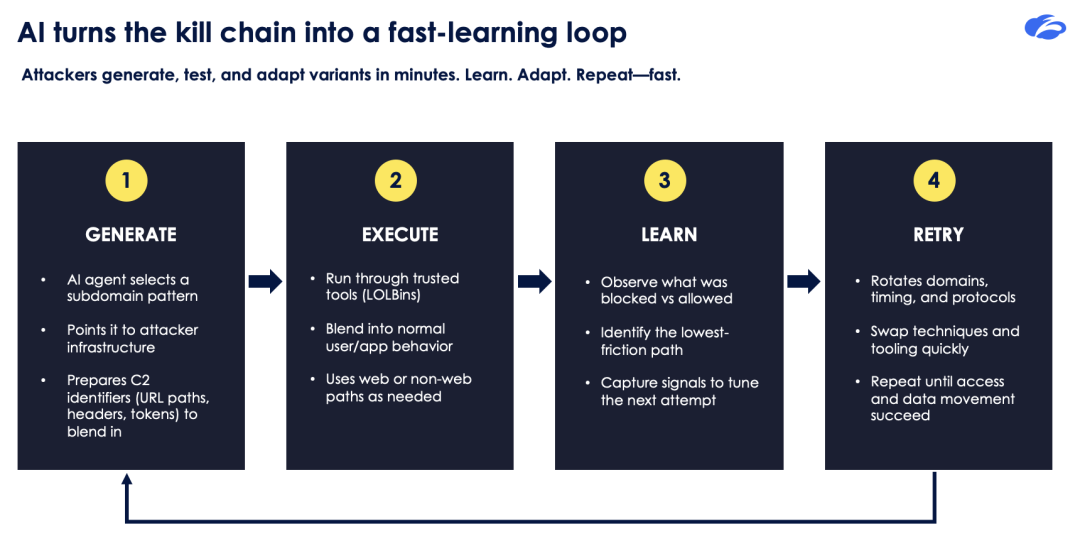
Traditional security models often treat the attack chain as a sequence of steps. AI turns it into a fast-learning loop:
- Generate – create a new variant, such as a subdomain pattern or command-and-control identifier.
- Execute – run the attack through trusted tools or blend into normal user and application behavior.
- Learn – observe what was blocked, what was allowed, and where friction is lowest.
- Retry – adjust domains, timing, protocols, and techniques, then launch again.
This allows attackers to evolve in near real time. Instead of relying only on known-bad indicators, they can gain a foothold using living-off-the-land techniques and keep adapting until access and data movement succeed.
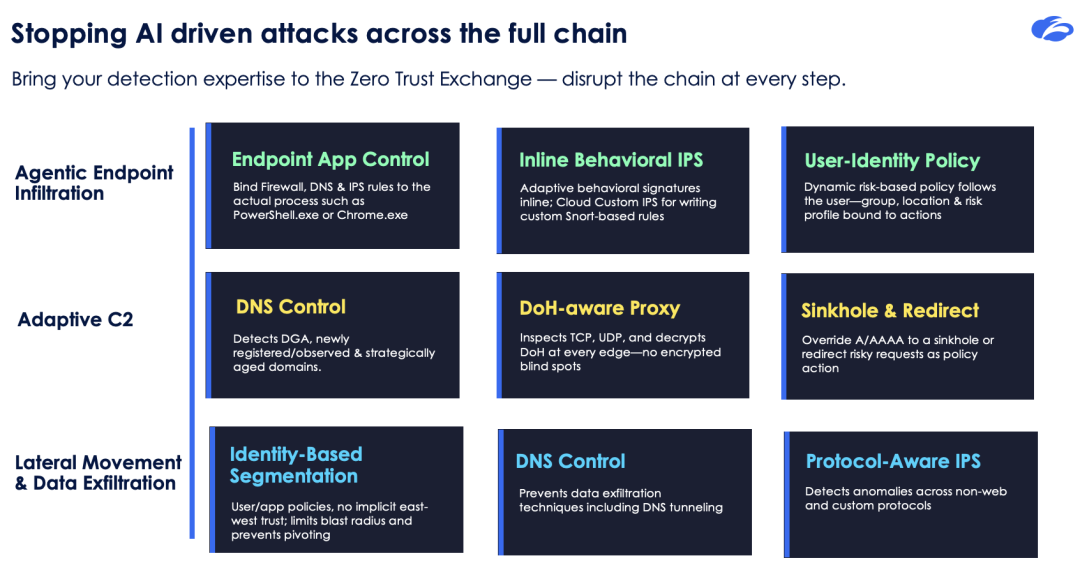
Three areas make this especially dangerous:
- AI agents on the endpoint: Attackers can use agentic, trial-and-error loops on compromised endpoints, leveraging legitimate tools and trusted processes without triggering static indicators of compromise.
- Adaptive command-and-control: AI helps attackers maintain outbound communication by rotating domains, switching between DNS, HTTPS, and DoH, and adjusting beacon timing to avoid detection.
- Lateral movement and data exfiltration: Once inside, attackers can pivot with protocols like RDP, SMB, and SSH, often using stolen credentials, then exfiltrate data in small encrypted bursts that resemble legitimate activity.
Zscaler's approach is to disrupt that attack loop at every stage rather than depend on a single inspection point.
- DNS Control helps detect suspicious domains, including DGAs, newly registered or newly observed domains, and strategically aged domains, while also helping stop exfiltration techniques such as DNS tunneling.
- DoH-aware proxying reduces encrypted blind spots by inspecting TCP and UDP traffic and decrypting DNS over HTTPS at the edge.
- Sinkhole and redirect capabilities can override risky DNS resolutions and cut off malicious communications before they are established.
- Inline behavioral IPS extends adaptive inspection beyond web traffic to the broader set of protocols attackers use for movement, control, and exfiltration.
- Endpoint App Control ties policy to the actual process generating traffic, such as PowerShell.exe or Chrome.exe, helping teams distinguish legitimate behavior from suspicious use of trusted tools.
- User-identity policy applies controls based on user, group, location, and risk, making security more dynamic and context-aware.
- Identity-based segmentation removes implicit trust between users and applications, limiting blast radius and making lateral movement much harder.
AI-driven attacks are faster, more adaptive, and better at blending into legitimate-looking traffic than many legacy defenses were designed to handle. The answer is not more perimeter appliances. It requires an architecture that reduces exposure, inspects traffic beyond the web, understands user, device, and process context, and disrupts the attacker's loop before it succeeds.
That is how Zscaler Zero Trust Firewall helps defend against AI-driven attacks: by making assets harder to discover, malicious communication harder to hide, and lateral movement harder to execute.
For security leaders, the takeaway is simple: when attackers can generate, test, learn, and retry at machine speed, defenses must be able to disrupt them across the full attack chain—not just at the perimeter.