Partner POV | It's all about physics: Why milliseconds make or break financial services transactions
In this article
Article written and contributed by, Digital Realty
Every millisecond of delay adds friction in financial services. For enterprises operating at scale, that friction can translate directly into failed transactions, compliance exposure, and eroded customer trust.
According to Oxford Economics' research into digital payments, 45% of consumers wouldn't retry a payment after a single false decline or timeout. When these systems delay or fail, you don't just risk losing a transaction; you risk losing the customer.
The modern financial services enterprise runs on real-time networks, algorithmic engines, and artificial intelligence (AI)-driven risk management. These environments are fundamentally different from those of a decade ago. As a result, an unavoidable and widening gap has emerged between legacy infrastructure strategies and real-time requirements.
As operating models shift toward instantaneous interactions, digital infrastructure can no longer sit far from the data, networks, and partners it depends on. The institutions leading the way in data and AI-driven trading, fraud prevention, and payments already recognize this. 79% of financial services companies follow a distributed approach to collect, store, and process their data to improve latency.
The question is no longer whether latency matters. It's whether you've positioned and architected your digital infrastructure to minimize it.
In this blog, we'll explore how latency impacts real-time financial services. Discover how physical location and connectivity adjacency determine transaction performance, and why the stakes have never been higher.
The real cost of latency to financial transactions
The physics of data transmission are fixed. Data travels through fiber optic cable at around 125,000 miles per second—close to the speed of light.
Every meter between the compute origin, each network point of presence (PoP), and the destination adds latency that no software can remove. For example, a bank placing its data 50 miles from a critical trading venue would introduce, at minimum, a round-trip delay of 0.8 milliseconds from distance alone. This is before accounting for network hops, switching overhead, or processing time.
Every millisecond saved represents an opportunity captured, a customer retained, and a mission-critical operation optimized for competitive advantage.
Legacy architectures may place critical workloads out of metro and far from partners, counterparty ecosystems, and liquidity centers. These designs were built for batch processing that fails in the real-time environments we see today. The consequences are measurable across many mission-critical functions of financial services, including:
- Real-time payments processing: Global payment networks impose strict end-to-end processing windows. Missing the thresholds can result in failed transactions, customer friction, and often lead to penalties from payment scheme operators. In a market where an end customer can switch providers in seconds, execution speed is a direct driver of retention.
- Fraud and anti-money laundering (AML) detection cycles: Regulatory frameworks increasingly require near-instant screening within transaction workflows. AML detection cycles must run throughout a transaction to analyze, score, and if necessary, block suspicious activity in microseconds. Unlike traditional batch processing, which reviews data after the fact, real-time monitoring operates in real time to prevent fraudulent funds from leaving an account.
- Trade execution: Latency in capital markets and foreign exchange has a direct, quantifiable impact on fill rates, pricing accuracy, and trading performance. Firms that can't achieve competitive proximity to trading venues are structurally disadvantaged, regardless of the sophistication of their models.
- Liquidity optimization: Real-time liquidity management requires continuous, low-latency data flows across systems and counterparties. Delayed infrastructure responses increase intraday risk exposure, forcing firms to hold higher, cost-inefficient liquidity buffers.
Applications must respond faster to avoid timeouts in transaction workflows that will cause failures. Digital infrastructure that can't meet these thresholds and deliver the latency required isn't just a performance concern. It's a fundamental business and regulatory risk for financial institutions.
Proximity and connectivity: The dual imperative
Eliminating latency isn't a single-variable problem. It demands two architecturally significant things of your digital infrastructure:
- To be strategically positioned in the right location(s)
- And, connected to optimal ecosystems
Physical location, network, and cloud adjacency are not alternatives; rather they're interdependent. Neither delivers its full value without the other.
Metro proximity: Competitive edge from the right metros
Where your data is located matters. The farther it is from key market locations, the more it erodes your competitive edge in latency-sensitive applications. For enterprises processing millions of transactions daily, these delays translate directly into significant revenue loss.
New York, London, Frankfurt, Singapore, Chicago, and Hong Kong are the world's largest financial hubs. They're the gravitational centers where global capital markets, payment networks, liquidity venues, and other critical counterparties orbit. They create rich, diverse ecosystems that real-time financial services require for operation.
High-frequency trading (HFT) illustrates how physical location is fundamental to latency. Even microsecond delays impact trading performance and profitability. By locating data infrastructure closer to exchange servers, HFT firms can minimize latency and gain a competitive edge in the markets.
When data workflows are tightly coupled with transaction or trade execution, the tolerance for latency shrinks dramatically, making in-metro proximity not just beneficial, but essential to performance. They can deliver exceptional customer experiences, turn data into a competitive edge, and capitalize on AI.
Deploying digital infrastructure in financial services requires strategic workload placement. Critical, latency-sensitive workloads must reside in close proximity to rich ecosystems, because each network hop compounds latency. Less critical workloads can be placed in connected campus locations to optimize costs while maintaining secure, reliable connections to those primary ecosystems. Realizing the adjacency and proximity value drivers of ecosystem alignment is fundamental to minimizing latency.
For strategic workload placement, the risk calculus is straightforward:
- Low risk – in-metro proximity: Front-office trading systems, payment processing engines, fraud detection, AML, and real-time risk models. The design minimizes latency, meets execution windows, and satisfies data residency compliance obligations.
- High risk – distant infrastructure: Distance introduces irreducible latency, execution delays and timeouts become a structural risk, and the business case for real-time capabilities erodes.
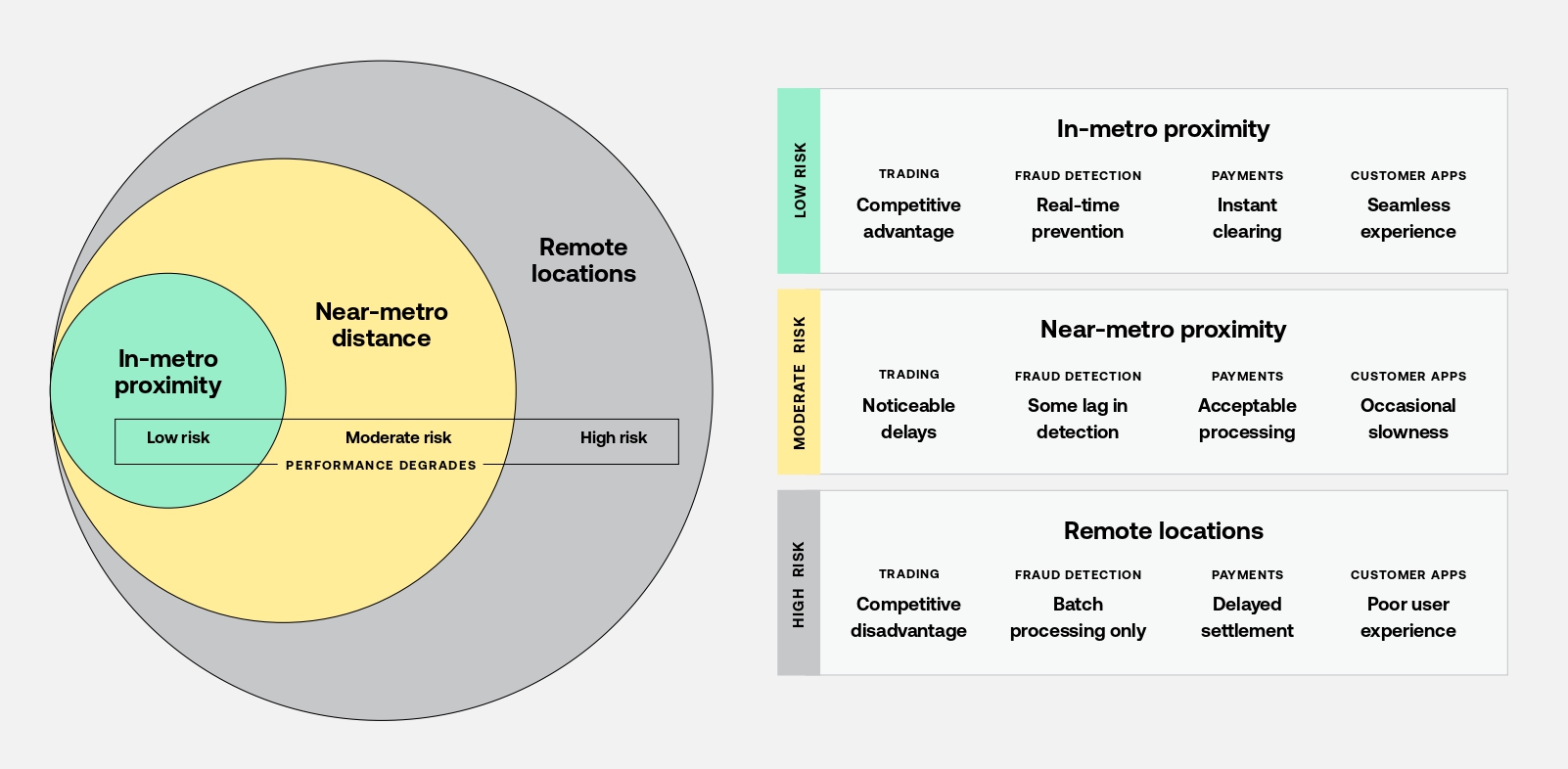
Legacy architectures often place critical workloads far from clouds, partners, or liquidity centers, and they prioritize throughput over speed. In today's real-time environments, that trade-off is no longer acceptable.
Physical location establishes the foundation. Connectivity determines how effectively that foundation performs.
Cloud and network adjacency: How the connectivity layer unlocks ecosystems
Being in the right data center in the right metro means access to a rich connectivity ecosystem. All while interconnected securely and at high speed, often through secure dark-fiber connections.
The concentration of connectivity available in colocation data centers is difficult to replicate elsewhere. It offers a strategic advantage that scales as data and workflows expand.
Colocation data center providers, like Digital Realty, provide direct interconnection to dense ecosystems of critical financial services partners, including:
- Trading exchanges
- Payment networks and processors
- Liquidity venues
- Market data feeds
- Cloud platforms
- Other counterparties
These interconnections in the same facilities are privately routed for enterprise-grade security. This reduces latency, improves reliability, and diminishes the exposure risks of public internet transit. Together, they form the connectivity fabric that transforms your data centers into connected communities and makes in-metro colocation operationally effective.
Leveraging ultra-low-latency and dark fiber access to the right clouds and networks can set performance apart from your competitors:
- Applications can respond faster, avoiding timeouts on key transactions that cause failure
- Analytics and optimization models can run closer to the data that feeds them
- AI workloads can operate with the immediacy they demand
Real-time infrastructure achieves what latency-sensitive markets require
The infrastructure demands of real-time financial workloads often exceed the capabilities of traditional architectures. Meeting these demands requires a combination of physical proximity, robust connectivity, operational resilience, and regulatory compliance.
Today's financial institutions are also facing a dual mandate: accelerate AI adoption while navigating an increasingly complex regulatory landscape. This puts pressure on enterprises to poise their infrastructure for the future of AI, whilst meeting mission-critical operations.
In latency-sensitive applications, colocation isn't simply an infrastructure decision—it's a competitive differentiator. Colocation data centers can enable data proximity and interconnections. Enterprises are increasingly leveraging connectivity fabrics to seamlessly interconnect to vital counterparties, market feeds, and trading venues that their workflows necessitate.
Digital Realty's ServiceFabric® is the largest secure, open fabric in the industry. It can empower customers to manage these critical network services and interconnect their hybrid IT architectures from a single point. This gives the flexibility and reach to route data exactly where it needs to go.
Proximity reduces latency at the source, optimizing execution speeds, workflow connections, and operational efficiencies. The performance benefits extend beyond speed, though. Robust redundancy frameworks ensure high availability and minimize downtime risk. This is critical when every outage carries revenue and regulatory consequences. Purpose-built, compliant environments reduce the governance burden for institutions operating across multiple jurisdictions.
According to Gartner, "by 2029, a third of the world's population will be linked by real-time payment schemes that join domestic payment schemes together."2 This would be achieved by joining domestic payment schemes together, across borders and jurisdictions. This scale of interconnected settlements demands that financial institutions prioritize a modern infrastructure foundation that's positioned at the center of those flows.
Across financial services, it's clear that milliseconds determine the win or loss of a transaction. The enterprises that treat digital infrastructure as a strategic variable—not a back-office detail—are the ones that will lead.
How Digital Realty powers financial services performance
Financial services continue to respond to technological advancements and changing market dynamics. To stay competitive, financial institutions must ensure their digital infrastructure is future-ready for proximity and connectivity and supports emerging technologies such as AI.
Colocation and global interconnection play a critical role, providing the flexibility and scalability needed to adapt to changing business needs.
Digital Realty's Colocation, ServiceFabric, and connected campuses support low-latency, power-intensive applications like AI, HPC, and advanced data analytics. Our global data center platform, PlatformDIGITAL®, offers standardized, HPC-ready infrastructure configurations to support high-density workloads.
By partnering with Digital Realty, enterprises can build the infrastructure necessary to deploy faster and reduce risk. Turning your physical infrastructure into a competitive edge.