Partner POV | The Anatomy of a Direct-to-Chip Liquid Cooling System
In this article
Article written by Lindsay Schulz, Global Principal & Sebastien Ye, Senior Product Manager, Equinix.
As AI accelerates, many conversations focus on the compute: deploying powerful GPU clusters and using them to train high-performance models, support inference workloads, and enable specialized use cases like high-frequency trading.
But a new constraint is emerging that's just as important as the compute itself: cooling.
Today's GPUs can reach power densities of more than 200 kilowatts per rack, and are trending toward 1 megawatt per rack. This is a dramatic increase from the 5–10 kilowatt environments data centers were designed to support just a few years ago. At these levels, traditional air cooling is no longer sufficient.
This shift is redefining how AI infrastructure must be built. It's now the cooling, not the compute, that's the biggest area of concern for many enterprises trying to scale their AI strategies.
Enterprises that treat cooling as an afterthought will struggle to scale AI workloads efficiently. Those that design for it from the outset will be better positioned to deploy, operate and expand high-performance environments.
In this context, liquid cooling is no longer an optimization. It's foundational infrastructure for AI.
Retrofitting air-cooled data centers is extremely complex and costly. Businesses can avoid this by partnering with a colocation provider that has a track record of operating AI-ready data centers. But before they deploy liquid-cooled hardware, colocation customers should know:
- The different components that make up a liquid cooling system
- The separation between what the facility provides and what they must bring for themselves
The four layers of direct-to-chip liquid cooling
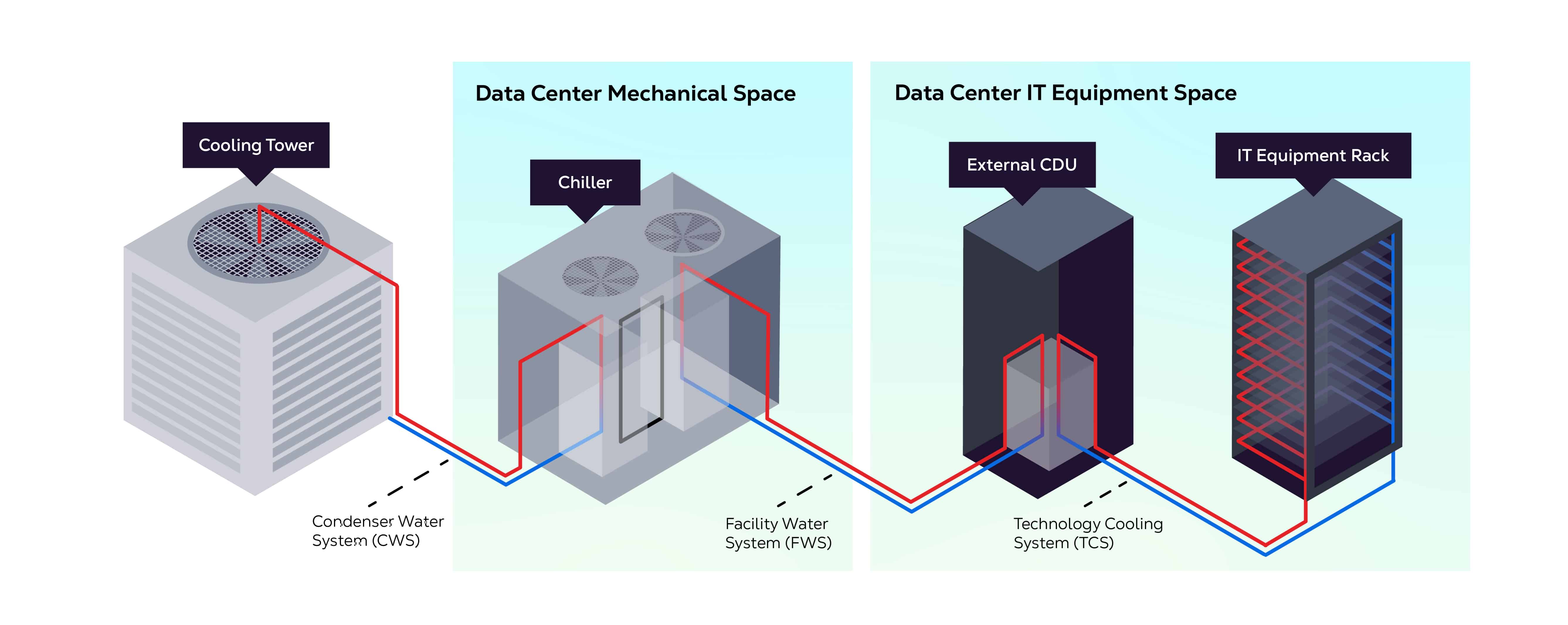
Direct-to-chip liquid cooling (DLC) has emerged as the dominant approach for supporting high-density AI infrastructure. At a high level, it can be understood as four interconnected layers.
1. Facility-level coolant distribution
At the foundation is the piping infrastructure that moves coolant throughout the data center. This consists of two closed loops:
- The primary loop from the facility's chiller to the coolant distribution unit (CDU)
- The secondary loop from the CDU to the server cooling infrastructure
These loops do not mix coolant. Instead, they transfer thermal energy between them using a plate heat exchanger within the CDU.
The secondary loop must be sized appropriately for the amount and density of servers the system needs to cool. The physical size of the pipe can limit the flow delivered to each individual loop. This is different from air cooling, where the cool air is typically distributed across an entire hall. As a result, data center operators need to plan for future growth when sizing the pipe.
2. Coolant distribution unit (CDU)
The CDU acts as the central exchange point between the facility and server cooling. Its role is to:
- Transfer cooling power from the building chiller to the servers
- Return heat from the servers to the building cooling system, where it's then rejected from the facility
To do this effectively, CDUs incorporate:
- The heat exchange plate that efficiently transfers thermal energy between the two loops
- Pumps that push coolant from the CDU to the server racks
- Filters to ensure the required level of purity for coolant entering the server racks
- Sensors to ensure coolant is distributed to the server racks at the right temperature and pressure
To protect servers against unplanned cooling outages, CDUs are typically designed and built for redundancy. This could mean N+1 redundant pumps within a CDU, redundant power connections within a CDU, and redundant CDUs within a facility.
3. Rack-level cooling and control
The CDU pushes liquid coolant through the secondary loop that connects directly to the racks. There are supply and return branches that distribute fluid to and receive fluid from each individual rack along the secondary loop.
At each branch, visibility and control are essential. Operators and customers need real-time insight into how cooling is performing at the rack level, and they need control over pressure and temperature levels. They can get this visibility and control thanks to:
- Temperature and flow sensors
- Pressure-independent control valves
- Self-modulating energy valves that can optimize thermal efficiency
The rack manifold distributes the coolant at the rack level. The flex hose to the rack manifold typically ends with a quick-disconnect coupling that easily connects customer equipment to the facility cooling system. This quick-disconnect coupling could be the logical place to mark the boundary where the data center operator's responsibility ends and the customer's responsibility begins.
4. Leak detection and containment
With liquid flowing through critical infrastructure, risk management becomes essential. This includes risks within your own colocation environment, but also for other customers in the surrounding areas.
Modern liquid cooling systems incorporate:
- Wireless spot devices for detecting leaks in specific high-risk spots.
- Rope-based devices for detecting leaks around the entire perimeter of a cabinet and potentially along vertical runs of pipes.
Data center operators typically use both devices alongside one another to provide the optimal mix of wide-reaching coverage and focused protection for certain areas.
Once a leak has been detected, it can be addressed using both human intervention and leak containment devices that automatically shut off valves to limit the damage.
Together, these systems ensure that liquid cooling can operate safely and reliably across many different customer environments.
Why liquid cooling is a shared responsibility
One of the most important—and often overlooked—realities of liquid cooling is that it's not owned by a single party. It's a shared system across an ecosystem:
- The customer procures the liquid-cooled hardware and coordinates between the OEM and the colocation provider.
- The OEM helps the customer identify specific temperature and pressure requirements for that hardware.
- The colocation provider creates rack-level cooling that aligns to those requirements.
Success depends on how well these elements are aligned. Without coordination, mismatches in temperature tolerance, pressure or flow can limit performance—or even prevent deployment.
This is why liquid cooling is more than just an engineering challenge. It's an integration challenge among partners. For instance, although there's a demarcation between the facility operator's infrastructure and the customer equipment, the coolant itself crosses the demarcation. This means that neither party has full ownership over the coolant.
The chemistry of the coolant is key to the health and longevity of liquid-cooled systems. Both parties must work together to ensure fluid quality, using established best practices for maintenance and operations on both sides of the demarcation. This is one factor that makes liquid cooling different from other colocation services like power and interconnection.
What liquid cooling means for business leaders
As AI adoption accelerates, cooling is moving from technical detail to strategic consideration. Three implications stand out:
- Cooling strategy must be part of AI strategy. Infrastructure decisions made early—especially around cooling—will determine how easily organizations can scale AI later.
- Retrofitting is rarely the optimal path. Designing for liquid cooling from the outset is typically faster, more cost-effective and less risky than modifying legacy environments.
- Partnership models matter more than ever. Because liquid cooling spans providers, customers and OEMs, organizations need partners who can coordinate across the entire ecosystem.
For all these reasons, enterprises should aim to work with a colocation partner that's not only experienced with the nuts and bolts of running liquid cooling infrastructure, but also experienced collaborating with customers to adapt that infrastructure to their unique needs.
Enabling AI-ready infrastructure with liquid cooling
To support high-density AI workloads, infrastructure must be ready before demand arrives. At Equinix, liquid cooling capabilities are built into our new data centers by default. This ensures customers can bring their liquid-cooled hardware online with ease.
Our approach is:
- Vendor-neutral, allowing customers to choose the hardware that meets their needs
- Reliable, with CDU redundancy for cooling and power redundancy that enables average uptime of >99.9999% globally
- Collaborative, helping customers align infrastructure with OEM specifications
In the AI era, success isn't just about accessing compute. It's about deploying that compute in environments that can support it reliably, efficiently and at scale. Liquid cooling is an essential part of this equation.