Partner POV | Your team is vibe coding apps. Here's how to publish them.
In this article
This article was contributed for publication by our partner, Island.
Vibe coding set off a Cambrian explosion of applications inside our organizations. Anyone, developer or not, can build an app before their coffee gets cold. Some last a week, some last an hour, and others become new ways to collaborate, running on agent-native software that keeps working after users log off. The future of work runs on this rhythm of constant creation, but only if we enable it for the enterprise.
For organizations to fully take advantage of the software employees are building, a faster product development lifecycle, ways for other employees to discover and use apps that have been created, and streamlined enterprise governance are needed.
They need vibe publishing for the enterprise.
Current enterprise processes no longer work
Until now, most enterprises launched a small number of internal apps. A problem needed to be big enough to justify the engineering resources. Now, vibe coding means that anyone can create an app in minutes, which causes the old way of launching these apps to completely break down.
Product development lifecycle
In California, a crew can frame a house in about thirty days. The permit takes at least ninety. Construction was never the thing holding up the project.
Enterprise software has the same shape. Every new application needs to be reviewed (often by different people) for everything from the architecture to regulatory compliance. This results in a bottleneck that cannot keep up with the large volume of vibe coded tooling.
Sharing and onboarding
Vibe coding means every dashboard, one-off automation, or niche tool can be made in minutes. Currently, this means users are building these apps and sharing URLs in emails and chats. That makes it very difficult for users to know about new apps, keep up with existing ones, and share their own apps with everyone who may benefit from it.
Enterprise governance
Internal applications often deal with sensitive information, and they may be connected to sensitive systems. This means organizations need a level of visibility, access control, endpoint posture assessment, and data protection to remain compliant with industry regulations and their own security standards. While the vibe coding platforms have some of these capabilities, such as integrations with identity providers (IdPs) that prevent apps from being publicly accessible, enterprise security requirements are extensive. Today, most vibe coded apps do not meet these requirements.
Vibe coding needs a partner and it's vibe publishing
If vibe coding is how your teams build, they need a matching way to ship. We call it enterprise vibe publishing.
Vibe coding lets anyone make software. Vibe publishing lets anyone share that software with their coworkers without putting the organization at risk. It makes it easy for admins to quickly review and approve vibe-coded apps, for end users to find and use them, and for security teams to gain visibility and enforce policies on them.
Introducing Island Enterprise Publishing
Island Enterprise Vibe Publishing is a governance and productivity solution that allows users to distribute vibe-coded apps to their coworkers with the visibility and controls that enterprises need. It works like this:
- An employee builds an app in any common vibe coding platform, such as Lovable, Claude Code, Replit, V0, etc.
- That app is deployed on the vibe coding hosting platform, which is integrated with the company's IdP
- The app is submitted through Island, which automatically prompts the admin to review
- The admin attaches the appropriate security and data protection policies and approves the app
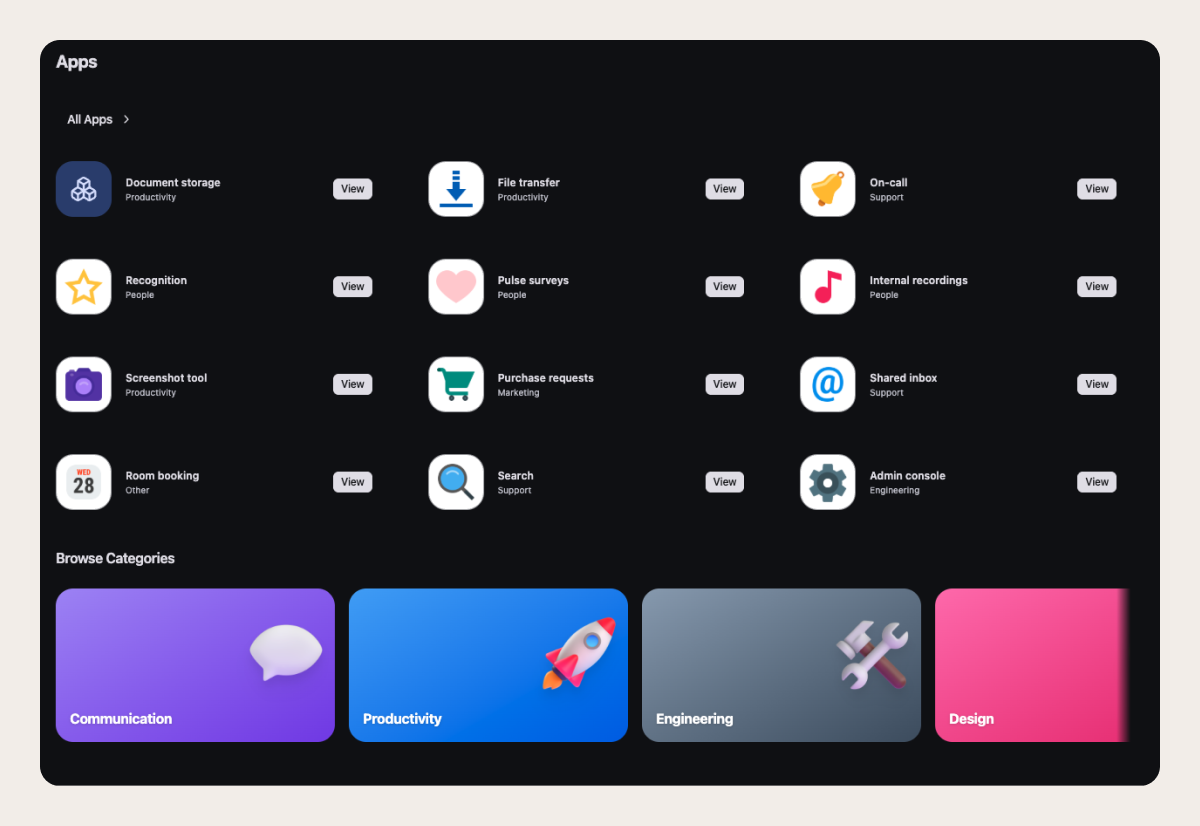
- The app is published to a centralized app library
- The admin has visibility into app traffic, a complete audit trail for compliance, and automated threat detection.
.png)
Review
When the user submits a vibe-coded app, the admin can quickly review it and the information they provided. In most cases, these apps simply need a standard policy that covers access control, data protection, and endpoint posture assessment. The admin can assign such a policy to a new app in a few button clicks with no additional configuration required. Once this is done, the builder can pick the appropriate audience and publish to the app library.
Discoverability
Every app is published to a centralized app library where users can search by category and owner. This allows them to easily find and discover internal apps. They can also request access to apps that weren't shared with them, and the app builder will approve or reject the request. Apps also appear on the homepage for the appropriate users, ensuring that they never miss new app releases.
Enterprise governance
Apps published with Island Enterprise Vibe Publishing benefit from all of the security policies available in Island. Apps are placed inside of the application boundary, which allows users to move data between them and other company apps, but not to personal applications. This includes clipboard controls, file upload/download, and screen sharing or screenshots.
Admins also get visibility into app performance and traffic with digital employee experience (DEX). This allows them to easily see when an app reaches a high level of adoption, which may warrant more support and oversight.
We deploy this ourselves
Island employees are vibe publishing our own apps.
As one example, we published our own internal AI Usage Dashboard through Enterprise Vibe Publishing. It's a live tool that gives employees insights into their AI usage and cost across platforms like Claude, Cursor, etc. and gives Island a view into how we can better enable our teams.
Other teams at Island have embraced vibe publishing to distribute custom dashboards, project trackers, automations, and more. This practice has spanned marketing, sales, customer support, engineering, and other internal teams. It has helped us become more efficient, faster, and more collaborative.

Embrace the vibes
Vibe coding settled the question of whether business users can build their own software. They can, and they already are.
The open question is how your organization consumes what they build. Island Enterprise Vibe Publishing answers it. You see what your people create, you control who reaches it and what data it touches, and your users get to hand their work to a coworker the same afternoon they built it. And end users get an app store experience, where they can find and discover all the apps they need.