Azure Local Unleashed: Key Announcements from Microsoft Ignite 2025 and Beyond
In this blog
Pre-Ignite 2025 Azure Local announcements
Just a few weeks ahead of MS Ignite 2025, Microsoft published a blog post highlighting new Sovereign Cloud capability. Sovereign Cloud is Microsoft's focus on European-based organizations and its digital commitments to empower those customers with greater choice, more control over data privacy, and more digital resilience. (Announcing comprehensive sovereign solutions empowering European organizations - The Official Microsoft Blog)
Powering the Sovereign Private Cloud is Azure Local, and the capabilities announced were anticipated as a preview of what was to come at MS Ignite 2025.
New Sovereign Private Cloud and AI capabilities
As organizations deepen their commitment to sovereignty, the ability to combine regulatory compliance with innovation becomes especially important. This next wave of enhancements helps bring together advanced AI capabilities and scalable infrastructure designed for both public and private environments.
Supporting thousands of AI models on Azure Local with NVIDIA RTX GPUs
As Microsoft advances in its Sovereign Private Cloud capabilities with Azure Local, they are introducing a new Azure offering with the latest NVIDIA RTX PRO™ 6000 Blackwell Server Edition GPU purpose-built for high performance AI workloads in sovereign environments.
Designed to run over 1,000 models such as GPT OSS, DeepSeek-V3, Mistral NeMo, and Llama 4 Maverick, this GPU enables organizations to accelerate their AI initiatives directly within a sovereign private cloud environment. Customers gain the flexibility to experiment, innovate, and deploy advanced AI solutions with enhanced performance. This means organizations can pursue new AI-powered opportunities while helping ensure data protection and compliance.
In addition, customers can gain access to thousands of prebuilt and open-source AI models, ready to deploy for a wide range of scenarios—from generative AI and advanced analytics to real-time decision making. This combination empowers customers to experiment, innovate, and operationalize cutting edge AI solutions, while keeping governance front and center.
Increasing Azure Local scale to hundreds of servers
Azure Local has supported single clusters of up to 16 physical servers. With the latest updates, Azure Local can support hundreds of servers, opening new possibilities for organizations with large-scale or growing sovereign private cloud demands. This enhancement means customers can support bigger, more complex workloads, scale their infrastructure with ease, and respond to evolving business needs all while aligning with the security and sovereignty required by European and global regulations.
SAN support on Azure Local
A key highlight of expanding the scale of our Sovereign Private Cloud is the introduction of Storage Area Network (SAN) support on Azure Local. With this update, customers can now securely connect their existing on-premises storage solutions from industry leaders to Azure Local. This integration empowers organizations to leverage their trusted storage investments while benefiting from cloud-native services, helping ensure data remains within their desired jurisdiction. European enterprises gain flexibility in meeting local data residency requirements without compromising on performance or control.
Microsoft 365 Local: General availability of key workloads
Another milestone is the general availability of Microsoft 365 Local, helping bring core productivity workloads—Exchange Server, SharePoint Server, and Skype for Business Server natively to Azure Local. Starting in December, customers can deploy these productivity workloads on Azure Local in a connected mode, with a disconnected option for complete isolation coming early 2026. This approach combines familiar collaboration tools with Azure Local's unified management and consistent Azure services and APIs, enabling organizations to maintain full operational control while aligning with stringent compliance and data residency requirements.
Disconnected operations: General availability
Microsoft's Sovereign Private Cloud extends sovereignty principles into fully dedicated environments for organizations with strict compliance and control requirements, enabled by Azure Local. Azure Local enables government agencies, multinational enterprises, and regulated entities to maintain local control while still benefiting from the scale and innovation of Microsoft's global cloud platform.
As part of Azure Local, Microsoft introduced the upcoming general availability of disconnected operations**, including the ability to manage multiple Azure Local clusters from the same local control plane**. Available in early 2026, this capability allows customers to operate private cloud environments with a completely on-premises control plane, enabling organizations to operate securely and independently within their own dedicated environments. With disconnected operations, customers can retain business continuity and operational resilience, even in highly regulated or edge scenarios.
Full Blog post: Microsoft strengthens sovereign cloud capabilities with new services | Microsoft Azure Blog
Ignite 2025 announcements
Azure Local at scale
Microsoft announced that Azure Local deployments can now scale to **hundreds of servers **using multi-rack deployments. This addresses the needs of larger private cloud deployments, allowing for greater compute density without managing multiple fragmented clusters.
- It is not based on Windows nor the Azure Stack HCI OS, but Azure Linux.
- The architecture is not based on hyperconverged infrastructure, uses separate 'Aggregation racks' with network and storage and 'Compute racks' where the compute runs.
- Uses Bare-Metal Machines (BMMs), physical servers in the compute racks exposed as firstclass Azure resources
- Runs an infrastructure Kubernetes cluster on Azure Linux BMMs to host virtualized and containerized workloads, instead of the classic failover cluster / Hyper-V model.

This bears a striking resemblance to Azure Operator Nexus, which was targeted towards large operations and specifically to Telcos. Full Blog post: Introduction to Azure Operator Nexus - Operator Nexus | Microsoft Learn
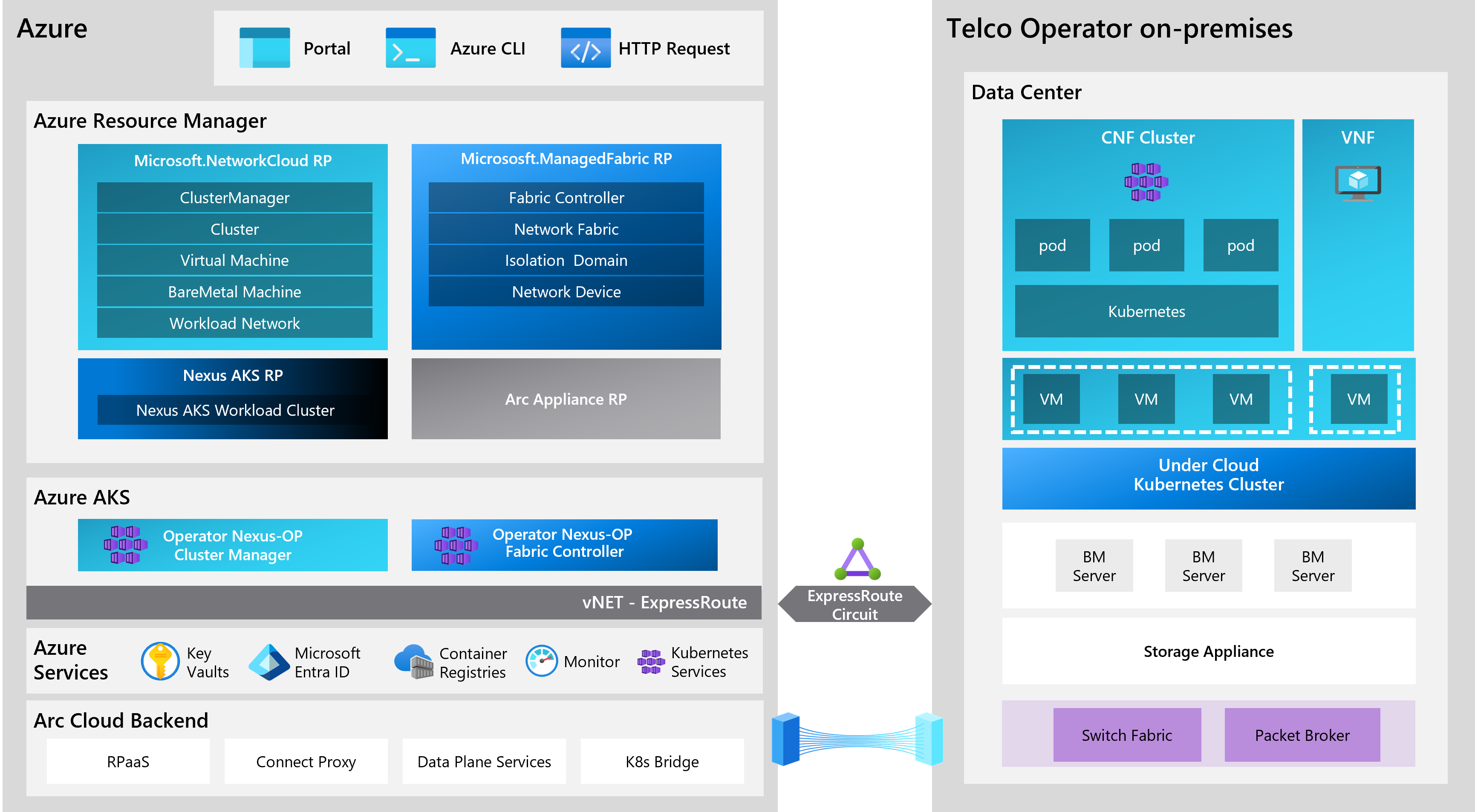
Why it matters: Large scale enterprises are looking for this level of scale in their Datacenters, Azure Locals limit of 16-nodes has been a blocker for this level of enterprise customer, the overhead of managing a multitude of clusters has been an operational barrier.
Azure Local SAN support
Azure Local now delivers greater infrastructure flexibility with expanded support for leading external SAN storage solutions, a capability that customers have long sought. Customers can now integrate their existing Fiber Channel-based SAN storage from leading vendors such as Pure Storage, NetApp, Dell, Lenovo, HPE, and Hitachi directly with Azure Local clusters. External storage support allows organizations to achieve high performance, scalability, and resilience while continuing to use their trusted storage infrastructure. It also enables consistent management across virtual machines, AKS clusters, and Arc-enabled services through the familiar Azure experience. Customers now have the freedom to modernize their environments while maximizing the value of their existing investments. Support for more Storage protocols and other storage capabilities coming soon.
Notes:
- First Fiber channel, on roadmap to support additional protocols.
- Only greenfield deployment (you cannot attach SANs to an existing instance as of now).
- You will need Storage Spaces Direct (S2D) together with SAN, not a SAN-only deployment.
Why it matters: The large enterprise has long invested in building trusted storage infrastructure and abandoning that investment has not been an option. Bringing connectivity to that infrastructure allows customers to continue to leverage those platforms for known performance, scalability, and resiliency.
Support for NVIDIA RTX PRO 6000 Blackwell Server Edition GPUs
Azure Local now supports the NVIDIA RTX PRO 6000 Blackwell Server Edition , generally available for high-performance workloads including AI inferencing, simulation, and visualization. This enterprise-grade GPU delivers exceptional compute density and energy efficiency, making it ideal for deployments that require advanced acceleration. Customers can deploy this powerful GPU in new Azure Local solutions—including Dell AX-770, Lenovo ThinkAgile MX650a V4, and HPE ProLiant DL380 Gen 12.
This expanded GPU support unlocks a range of edge use cases that fulfill the stringent requirements of critical infrastructure for our healthcare, retail, manufacturing, government, defense, and intelligence customers. This may include real-time video analytics for public safety, predictive maintenance in industrial settings, rapid medical diagnostics, and secure, low-latency inferencing for essential services such as energy production and critical infrastructure. Earlier this year, Microsoft announced a multitude of AI capabilities at the edge, all enriched with NVIDIA accelerated computing:
- Edge Retrieval Augmented Generation (RAG): Empower sovereign AI deployments with fast, secure, and scalable inferencing on local data—supporting mission-critical use cases across government, healthcare, and industrial automation.
- Azure AI Video Indexer enabled by Azure Arc: Enables real-time and recorded video analytics in disconnected environments—ideal for public safety and critical infrastructure monitoring or post-event analysis.
Why it matters: By embedding AI into edge operations, industries are unlocking transformative efficiencies and innovations. In manufacturing, edge-powered AI enables real-time quality control and predictive maintenance, minimizing downtime and maximizing productivity. In retail, AI enhances customer experiences with personalized recommendations and streamlined inventory management. Similarly, finance leverages AI's capabilities for robust fraud detection and advanced risk management. Moreover, sectors like government and defense are increasingly adopting edge AI for safety-critical applications, enabling autonomous, real-time surveillance and response solutions that are both efficient and resilient. These advancements are paving the way for scalable, adaptive solutions that meet the unique demands of diverse operational environments.
Network segmentation (SDN)
To protect and isolate your network traffic between VMs or logical networks, Azure Local now supports network security groups (NSGs), generally available as of the 2510 release. NSGs enable precise filtering of network traffic using policy-driven access controls by applying inbound and outbound allow/deny rules. Rules support the full five-tuple of source IP, source port, destination IP, destination port, and protocol, and are enforced within the virtual switch at the virtual port level. NSGs can be applied to both logical networks and individual network interfaces and can be managed using the Azure Portal for centralized policy management of your edge workloads.
Full Blog post: Announcing General Availability of Software Defined Networking (SDN) on Azure Local | Microsoft Community Hub
Why it matters: Software Defined Networking (SDN) forms the backbone of delivering Azure-style networking on-premises. Whether you're securing enterprise applications or extending cloud-scale agility to your on-premises infrastructure, Azure Local, combined with SDN enabled by Azure Arc, offers a unified and scalable solution.
Key highlights are:
- Centralized network management: Manage Logical networks, network interfaces, and NSGs through the Azure control plane – whether your preference is the Azure Portal, Azure Command-Line Interface (CLI), or Azure Resource Manager templates.
- Fine-grained traffic control: Safeguard your edge workloads with policy-driven access controls by applying inbound and outbound allow/deny rules on NSGs, just as you would in Azure.
- Seamless hybrid consistency: Reduce operational friction and accelerate your IT staff's ramp-up on advanced networking skills by using the same familiar tools and constructs across both Azure public cloud and Azure Local.
Rack Aware Clusters
Rack aware clustering is now available in preview for Azure Local, enabling intelligent placement and resiliency across multi-rack deployments using one storage pool. This feature allows Azure Local to detect physical rack boundaries and distribute workloads accordingly, improving fault tolerance and minimizing impact from localized hardware failures. It's especially valuable for larger deployments where high availability and service continuity are critical. Rack awareness integrates seamlessly with Azure Local's update orchestration and VM placement logic, helping ensure infrastructure stays resilient at scale.
Conclusion
As we look ahead, the innovations unveiled at Microsoft Ignite 2025 mark a pivotal moment for organizations seeking to balance agility, compliance, and innovation in the era of sovereign and private cloud. With Azure Local's expanded scale, SAN support, NVIDIA GPU integration, and the general availability of Microsoft 365 Local, enterprises now have the tools to unlock new possibilities—whether modernizing infrastructure, accelerating AI initiatives, or meeting the most stringent regulatory requirements. These advancements empower organizations across industries to confidently embrace the future, knowing they can innovate securely, efficiently, and in full alignment with their unique operational needs. Stay tuned as WWT continues to guide and support your journey through this exciting new chapter in cloud transformation.