Partner POV | Cisco and Equinix Are Expanding Collaboration on Hybrid Multicloud Connectivity
In this article
Article written by Kevin Skahill, Sr. Director of Product Management for Edge Services, Equinix.
Enterprise networks are struggling to keep up with the needs of modern digital businesses. Applications spanning multiple clouds—including hyperscalers and AI-focused neoclouds—is the new standard. The question now is how to interconnect users, branches and multicloud environments through a single architecture that delivers consistent policy, visibility and performance.
But the challenge is evolving. As AI workloads, neocloud providers, and more distributed application architectures become common, traditional SD-WAN and hub-and-spoke designs are being pushed beyond what they were originally designed to handle.
As they navigate the complexities of hybrid multicloud connectivity, enterprises continue to run into familiar challenges, including:
- Public internet dependency: Branch-to-cloud traffic crosses the public internet with no SLAs. This inevitably leads to higher latency, packet loss, and security exposure.
- Cloud sprawl: Traditional deployments often require separate appliances for each cloud provider. Operational complexity and licensing overhead increase with each new cloud added.
- Slow provisioning: Today's businesses often need new connections within minutes, but traditional dedicated cloud connections can take weeks or even months to provision.
- Inconsistent security policies: Without a centralized control point, security and segmentation policies drift across cloud environments, creating compliance gaps.
- Fragmented visibility: Each cloud provider has its own monitoring console, leaving network teams without the end-to-end view needed to diagnose problems quickly.
- Unpredictable egress costs: Inefficient traffic routing through centralized data centers or across regions drives up cloud data transfer fees.
By now, it's clear that enterprises need a new way to do hybrid multicloud networking. Yet many organizations still rely on outdated approaches like VPN tunnels, manual routing, and cloud-specific configs that fall out of sync. This leads to poor app performance and inconsistent security policies and keeps IT teams bogged down in troubleshooting issues.
These challenges are driving a shift toward new networking approaches that are more software-defined, distributed, and tightly integrated with cloud and ecosystem connectivity. Cisco and Equinix are working together to explore a new approach to these challenges, extending SD-WAN into interconnection environments. One example of this approach is the deployment of Cisco Meraki vMX on Equinix Network Edge. This is an extension of our joint software-defined cloud interconnect (SDCI) solution with Cisco, which makes Cisco's SD-WAN capabilities available on Network Edge. Now, we're bringing those same capabilities to Cisco Meraki customers.
Bringing together the best of Cisco with the best of Equinix
As part of this effort, Cisco and Equinix are working together to extend Cisco Meraki's cloud-managed SD-WAN capabilities into Equinix's interconnection environments. Instead of stitching together VPN tunnels, enterprises can connect their different branch offices, colocation environments and cloud services into Cisco Meraki vMX hubs.
These hubs can be deployed across multiple metros globally, creating a distributed cloud hub architecture that enables local breakout near users and cloud destinations. At the same time, enterprises can maintain centralized policy and traffic management through the Cisco Meraki Dashboard. In this model, Equinix Network Edge acts as an interconnection point where SD-WAN capabilities can be deployed closer to cloud and ecosystem connectivity.
Equinix Network Edge is a portfolio of virtual network functions (VNFs) from leading providers like Cisco, including routers, firewalls, and SD-WAN gateways. Enterprises can currently deploy these VNFs in 32 strategic global metros, with no physical hardware required.
Deploying a Cisco Meraki vMX instance on Network Edge creates a private interconnection point that can aggregate, control and route traffic across multiple clouds simultaneously. This happens via Equinix Fabric® virtual connections, allowing enterprises to reduce reliance on the public internet and its associated performance and security challenges.
Branch offices connect to the hub via the Cisco Meraki Auto VPN (SD-WAN) secure connectivity solution. After traffic arrives at the hub, it can then travel onward to any connected cloud via private connectivity.
The solution includes the Cisco Meraki Dashboard, a unified interface for managing security policies, traffic shaping, segmentation, and monitoring. This is the same dashboard that users may already be familiar with from managing physical Cisco Meraki MX branch appliances.
Simplifying multicloud connectivity with a hub-and-spoke architecture
While hub-and-spoke architectures are not new, extending them into interconnection environments changes how they can be applied in multicloud scenarios. Using a hub-and-spoke topology, enterprises can avoid the challenges that often arise when manually piecing together cloud connections.
How it works:
- In a typical deployment, enterprises start by deploying a single vMX hub on Equinix Network Edge in their chosen metro location.
- They can connect that hub to multiple cloud providers via Equinix Fabric. This could include using the clouds' own dedicated connections: Direct Connect for AWS, ExpressRoute for Microsoft Azure, and Cloud Interconnect for Google Cloud.
- If needed, enterprises can set up additional vMX instances in separate clouds or remote environments. These operate as spokes of the primary hub.
- Branch sites with physical Cisco MX appliances can form Auto VPN (SD-WAN) tunnels back to the hub over the internet.
The vMX hub is connected to a Cisco Catalyst 8000V router that can help steer traffic to different cloud destinations over a single set of Equinix Fabric virtual connections.
Different options for different environments
The preview currently supports two deployment modes, allowing enterprises to select the option that best meets their needs:
- Classic Mode: A straightforward internet-facing deployment. The vMX WAN interface is assigned to a public IP address through the Equinix Internet Access (EIA) service.
- Air-Gapped Mode (vMX's pass-through VPN concentrator mode): The vMX instance sits behind a firewall or helper device intended to provide the needed DHCP and NAT capabilities. This can allow the vMX to establish a secure outbound connection to the Cisco Meraki Orchestrator with no public WAN exposure. This mode also supports static IP assignments. The LAN interface remains fully available for downstream use cases like colocation network connections and route aggregation.
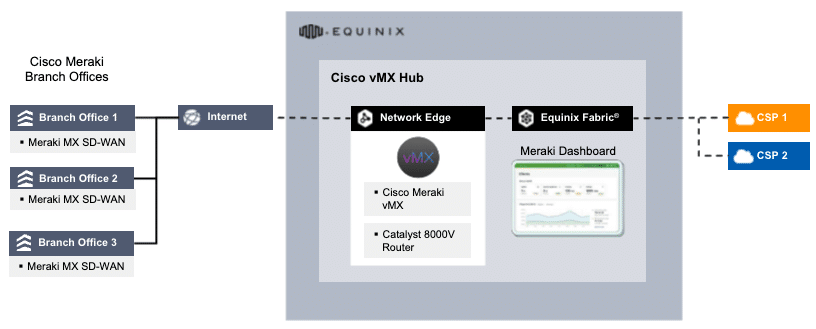
How enterprises can use vMX on Equinix Network Edge
Early customer deployments are exploring several use cases, including:
- Multicloud connectivity from a single hub: One Cisco Meraki vMX instance on Equinix Network Edge connects to AWS, Azure and Google Cloud simultaneously over private Equinix Fabric connections, eliminating cloud appliance sprawl.
- Branch SD-WAN with private cloud access: Cisco Meraki Auto VPN (SD-WAN) tunnels connect branch offices to the vMX hub. The hub offloads cloud traffic from the internet and delivers it to cloud providers using private connectivity.
- Rapid access to cloud on-ramps: New locations need enterprise-grade cloud connectivity without waiting weeks for physical circuits. Equinix Network Edge delivers this in minutes, thanks to Equinix's industry-leading cloud on-ramp portfolio.
- Compliance-hardened environments: The air-gapped deployment mode targets financial services, healthcare, and other regulated sectors that require strict network isolation with no public WAN exposure on the virtual appliance.
- AI and ML workload connectivity: Organizations accessing GPU as a Service (GPUaaS) offerings from neoclouds need low-latency, high-bandwidth connectivity without internet variability. The vMX hub on Equinix Network Edge uses this approach to establish lower-latency, more predictable connectivity paths to distributed AI compute.
What this means for technical leaders
While still in preview, this approach is designed to deliver several potential benefits:
- Private, predictable performance: Equinix Fabric's private backbone offers a 99.999% uptime SLA. It also allows enterprises to avoid the public internet between branches and cloud workloads.
- Faster deployment: With virtual circuit provisioning, what once took weeks or months can now be completed in minutes.
- Operational simplicity: The Cisco Meraki Dashboard is the single pane of glass for managing Cisco branch appliances, vMX hubs, security policies, and SD-WAN, anywhere in the world.
- Consistent security: Encrypted SD-WAN tunnels over Equinix Fabric, combined with unified Cisco Meraki policy enforcement, ensures consistent segmentation and access control across all environments.
- Lower total cost: Eliminating unnecessary backhaul cuts cloud egress charges, and consumption-based billing means no up-front CAPEX and no hardware to maintain.
- Global scale: Enterprise leaders can choose from 32 strategic global metros, making it easy to place vMX hubs close to users, clouds and partners.
- High availability: Redundant vMX instances deployed as tunnel pairs support active-passive or active-active configurations, with Cisco Meraki Auto VPN (SD-WAN) providing automatic failover between hub paths.
What's emerging as unique about this approach?
Even at this early stage, several factors are emerging that differentiate this approach:
The combination of Cisco Meraki vMX's simplicity with Equinix's scale
Cisco Meraki is the industry's most widely deployed cloud-managed SD-WAN and security platform for distributed enterprises. Equinix is the world's largest carrier-neutral colocation and interconnection provider. Deploying Cisco Meraki vMX on Equinix Network Edge puts these two capabilities together, enabling rapid time-to-market for customer deployments while reducing operational costs.
Cloud-agnostic connectivity
Neither Cisco nor Equinix is aligned with any single cloud provider. Enterprises can connect to AWS, Microsoft Azure, Google Cloud, Oracle Cloud, and neocloud providers simultaneously and change that mix over time without needing to re-architect the underlying network.
Different deployment options for different enterprises
Most SD-WAN virtual appliances are designed exclusively for internet-facing deployments. This makes them a poor fit for compliance-driven enterprises that need the operational benefits of cloud-managed SD-WAN, but also need to avoid any public WAN exposure of their network appliances. For this large and traditionally underserved segment, the Air-Gapped Mode deployment option is essential.
This work reflects a broader shift in enterprise networking. As applications, data and AI systems become more distributed, connectivity is moving closer to where workloads run—across clouds, ecosystems and edge locations. Extending SD-WAN into interconnection environments is one way that enterprises are beginning to adapt.
Learn more and join the preview program
Whether your organization needs to connect multiple clouds over a private backbone, extend a Cisco Meraki SD-WAN fabric into your colocation environment, or establish secure cloud connectivity in a compliance-hardened architecture, Cisco Meraki vMX on Equinix Network Edge can help.
Cisco Meraki vMX on Equinix Network Edge is available now in preview, with general availability targeted for February 2027. Preview participants can validate the architecture in production, build operational familiarity, and provide direct feedback to Cisco and Equinix engineering teams.